The Reactants of Enzyme Catalyzed Reactions Are Known as
The reactants in an enzyme-catalyzed reaction are called the enzymes substrates and the substances produced in the reaction are called products. What are the reactants of Calvin reactions.
Enzymes Catalysis And Kinetics
Science Biology QA Library For the enzyme-catalyzed reaction shown in the figure which of these treatments will cause the greatest increase in the rate of the reaction micromolar.
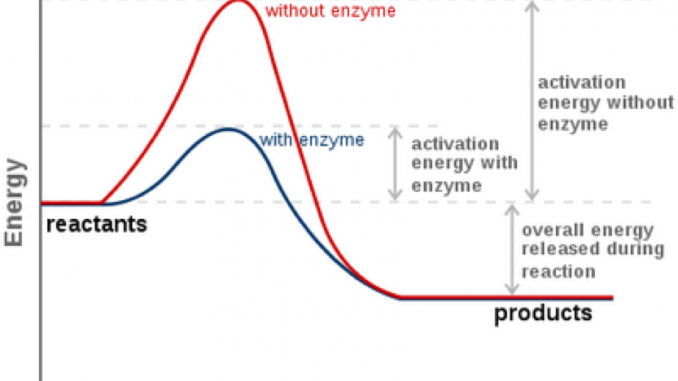
. Enzymes are molecule catalysts usually proteins with the ability to speed up a chemical reaction by lowering activation energy. A substance that speeds up the rate of a chemical bond. The study of the composition and function of the enzymes is known as enzymology and the expert or specialist in enzymes is called an enzymologist.
There may be one or more substrates depending on the particular chemical reaction. The binding together of an enzyme and a substrate forms a an _______. This property of a biochemical reaction is important because it determines the change in the apparent equilibrium constant K with pH.
The beginning substances in a chemical reaction are known as the reactants. For example the enzyme acetylcholinesterase catalyzes the decomposition of the neurotransmitter acetylcholine to choline and acetic acid. The reactants are ATP CO2 and NADPH from the Light Dependent Reactions.
Substrate is a broadly used term but it is mainly used when talking about biochemical functions. Enzymes are highly specific catalysts for biochemical reactions with each enzyme showing a selectivity for a single reactant or substrate. The elements or compounds produced by a chemical reaction.
The reactants of enzyme-catalyzed reactions are known as _____ Substrates. Chemists call the energy needed to get a reaction started the ____. The binding together of an enzyme and a substrate forms aan YOU MIGHT ALSO LIKE.
In some reactions a single reactant substrate is broken down into multiple products. Furthermore what are the reactants of enzyme catalyzed reactions known as. O doubling the concentration of the reactants from 10 to 20 micromolar O tripling the concentration of the reactants from 10 to 30 micromolar O reducing the AG cooling the.
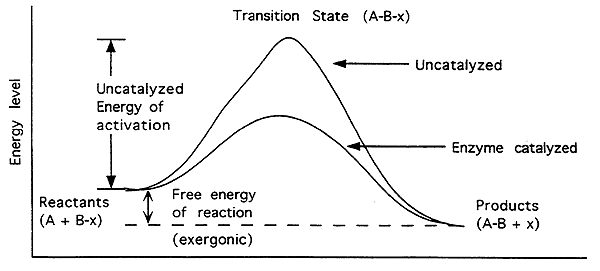
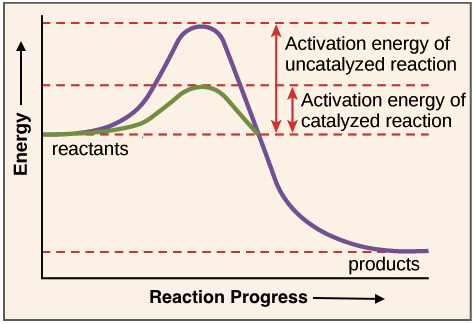
A catalyst does this by lowering a reactions activation energy. Why are the active site and the substrates in an enzyme-catalyzed reaction often compared. Catalysts In enzyme catalyzed reactions the reactants go to a high-energy transition state before conversion to the products.
What is an example of an enzyme catalyzed reaction. In the uncatalyzed reaction the substrate also goes through the same transition state but the energy of this state is higher in the absence of the enzyme we can model the rate of each reaction as k nreactants. Catalysts In enzyme catalyzed reactions the reactants go to a high-energy transition state before conversion to the products.
The determination of apparent equilibrium constants and heats of enzyme-catalyzed reactions provides a way to determine DeltafG degrees and DeltafH degrees of species of biochemical reactants. In the general sense substrates are the chemical species being observed during the reaction ie. They are generally known as substrates.
Catalysts In enzyme catalyzed reactions the reactants go to a high-energy transition state before conversion to the products. The reactants are ATP CO2 and NADPH from the Light Dependent Reactions. What are the reactants of Calvin reactions.
In reversible reactions one direction will. To address this challenge we have developed a quantum chemical calculation method that can. Produce energy and the other direction will require energy.
2 hours agoThe long-due development of a computational method for the ab initio prediction of chemical reactants that provide a target compound has been hampered by the combinatorial explosion that occurs when reactions consist of multiple elementary reaction processes. These calculations are more difficult than the calculation of transformed thermodynamic properties from. Chemistry - TEAS Science PreNursingSmarterPro TEAS Guide.
Most enzyme-catalyzed reactions produce or consume hydrogen ions and this is expressed by the change in the binding of hydrogen ions in the biochemical reaction as written in terms of reactants sums of species. The reactants of enzyme-catalyzed reactions are known as. The reactants of enzyme-catalyzed reactions are known as substrates.
A substrate is a reactant that is used by an enzyme. Proteiins that act as biological catalysts. The reactants of enzyme-catalyzed reactions are known as.
The correct answer was given. This site is the active site of an enzyme. Reactants of an enzymatic reaction are substrates and they are being changed.
In the uncatalyzed reaction the substrate also goes through the same transition state but the energy of this state is higher in the absence of the enzyme we can model the rate of each reaction as r k nre actants. The energy to get a reaction to go is called the __________. The chemical reactants to which an enzyme binds are called the enzymes substrates.
In the biochemical sense this is the molecule that the enzyme is reacting with. The reactants of enzyme-catalyzed reactions are known as. Section 24 - Chemical reactions and enzymes16 Terms.
The reactants of an enzyme-catalyzed reaction are know as. Enzymes dont undergo any permanent chemical change. In the uncatalyzed reaction the substrate also goes through the same transition state but the energy of this state is higher in the absence of the enzyme.
The correct answer is. Enzymes provide a site where reactants can be brought together to react reducing the energy needed for a reaction.

Enzymes Boundless Biology
Enzymes Review Article Khan Academy
Rate Of Enzyme Reactions And Factor Affecting The Rate Of Enzyme Reactions Online Biology Notes


Comments
Post a Comment